

The Institute asked Douglas Wallace of Dalhousie University, Canada Research Chair and Canada Excellence Research Chair Laureate in Ocean Science and Technology, to explain what role the oceans could play in meeting Canada’s net zero commitments.
The Institute’s report outlining Canada’s pathways to reaching net zero, Canada’s Net Zero Future, recommended a broad portfolio of solutions including “safe bets” like non-emitting electricity, and “wild cards” that may play a role, including nature-based solutions. While nature-based solutions do not replace the need to dramatically reduce fossil fuel emissions, the enhancement of natural sinks for carbon dioxide could prove essential if emission reductions continue to be inadequate. One such solution that has so far received scant attention is, well, a solution—of carbon dioxide within ocean waters—and it now requires .
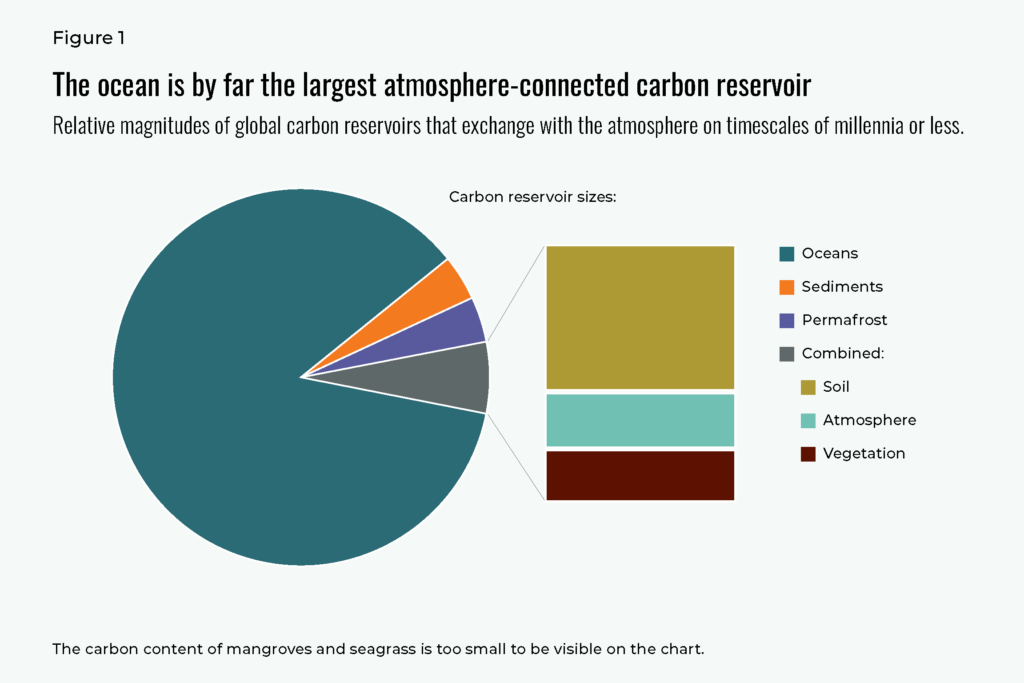
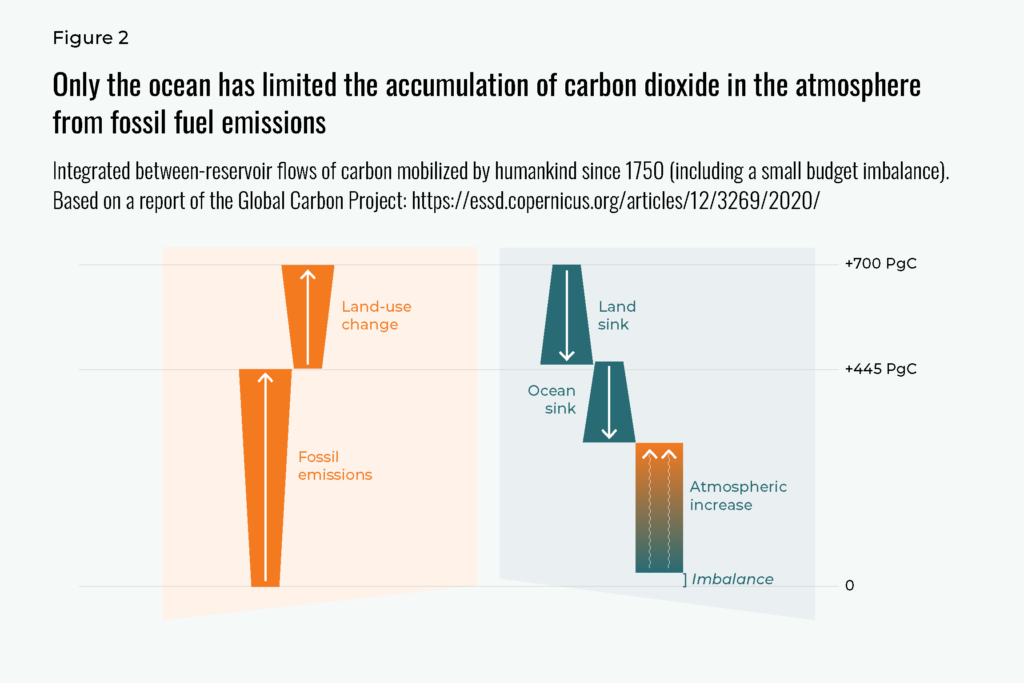
The ocean is, by far, the largest carbon reservoir connected to the atmosphere (Figure 1). Over the past 270 years, only the ocean has been effective in limiting accumulation of carbon dioxide in the atmosphere due to fossil-fuel combustion (Figure 2). In contrast, the carbon reservoir on land has remained almost constant in size despite massive changes in land use. Over the past one million years, storage of inorganic carbon in the deep ocean interior was responsible for the that accompanied the ice ages.
Despite this importance, a of natural climate solutions lists only “global forests, wetlands, grasslands and agricultural lands.” And the ocean was almost invisible in the Canada’s Net Zero Future report, with the word land appearing 94 times and ocean only twice.
Natural, but not biological
The ocean’s present-day carbon sink—its ability to reduce climate change by pulling carbon dioxide out of the atmosphere—differs fundamentally from land-based and coastal sinks, in part because its carbon capture process relies on chemistry rather than biology. The ocean sink involves carbon dioxide dissolving in water and reacting with both water and dissolved alkaline substances (such as carbonate ions dissolved from carbonate rocks). These reactions take place globally and are abiotic—which means they don’t involve living organisms directly. They have operated throughout Earth’s history and are thoroughly “natural.”
Given this, it may be surprising that most discussion of carbon dioxide removal by the ocean focusses on biotic processes: enhancing capture of carbon by photosynthetic organisms, as on land. This started with the early idea of but extends now to other, less controversial approaches, including enhanced growth of seaweed, seagrass, and mangroves in the coastal zone. Blue carbon can be thought of as a marine analogue or extension of land-based solutions. An aquatic version of Bioenergy with Carbon Capture and Storage (A-BECCS), involving seaweed farming, has also been proposed.
Blue carbon blues
A focus on ocean carbon removal by photosynthesis risks obscuring the reason that the ocean has been effective as a sink in the first place, which is seawater chemistry. It may also involve ethical and safety-related issues.
Blue carbon will not contribute significantly to global-scale mitigation of climate change, and its over-promotion even risks distracting or misleading policymakers, politicians, and the public.
A major problem is that the amount of carbon that can be sequestered by blue carbon interventions in coastal environments is extremely limited because the carbon reservoirs themselves are so small (Figure 1). Even the most optimistic estimates of blue carbon sequestration potential of the world’s annual fossil fuel emissions, and sequestering that much carbon would require restoration of wetlands on a massive, global scale. This, in turn, would impact land use and livelihoods in developing countries, and raise questions about the role of the Global South in mitigating problems caused largely by the Global North, and, as with land-based carbon dioxide removal, whether costs and benefits could be shared equitably. While important benefits to ecosystems and biodiversity would accrue, blue carbon will not contribute significantly to global-scale mitigation of climate change, and its over-promotion even risks distracting or misleading policymakers, politicians, and the public with well-intentioned but ultimately ineffective approaches.
The ocean presents other challenges for carbon dioxide removal that relies on photosynthesis and biomass growth. For example, ocean iron fertilization was based on enhancement of photosynthesis and was determined, by some, to be risky and . More generally, enhanced conversion of inorganic carbon dioxide to organic carbon (biomass) can have unintended consequences. For example, growth of biomass requires nutrients that are usually in short supply in the ocean. There is a risk that carbon dioxide removal robs essential nutrients from other fragile ecosystems, so sources and demands for nutrients must be considered very carefully.
Any additional organic carbon produced by blue carbon interventions would have to be sequestered , through sediment burial, sinking to the deep ocean, or some other form of carbon preservation. Otherwise, it will simply be respired and returned rapidly to the atmosphere as carbon dioxide. If sequestered in the deep sea, respiration of the additional organic carbon would contribute to ocean acidification and . Efforts to harness ocean biota to reduce atmospheric carbon dioxide should be considered but must take this potential for unintended consequences into account.
Abiotic ocean sequestration is permanent and makes use of processes that have removed carbon dioxide from the atmosphere effectively over geological time.
Abiotic, chemical solutions may be the fix
Abiotic carbon dioxide removal has than blue carbon. As a result, Canadian researchers and private sector innovators are starting to investigate approaches based on harnessing the chemical ability of , or , to react with or “neutralize” carbon dioxide. This can be achieved by adding alkaline substances such as carbonates or, more likely, hydroxide ions to surface seawater, which enables seawater to take up more carbon dioxide from the atmosphere. An alternative is to use the natural ability of rock minerals in the oceanic crust to react with carbon dioxide via chemical weathering reactions. Other approaches are likely to emerge. In marked contrast to carbon storage in forests, which is subject to re-release due to fire and disease, abiotic ocean sequestration is permanent and makes use of processes that have removed carbon dioxide from the atmosphere effectively over geological time. The reactions do not involve direct intervention with living organisms, so they are potentially both effective and low impact for marine ecosystems, though this remains to be tested.
Are abiotic solutions restorative?
The world’s oceans have absorbed so much of the carbon dioxide from our burning of fossil fuels—up to —that seawater chemistry has changed globally. This is the end result of uncontrolled, unregulated, unbalanced “ocean dumping,” on a global scale, of an industrial waste product: carbon dioxide. The resulting ocean acidification is of increasing concern for marine ecosystem health.
Chemical changes driven by carbon dioxide uptake have also decreased the ocean’s effectiveness as a carbon sink. This highlights another key difference between land and ocean: whereas higher atmospheric carbon dioxide drives increased carbon uptake on land due to carbon dioxide fertilization of plant growth, the effect is the opposite in the ocean. Uptake of carbon dioxide has reduced the by 40 per cent since 1750.
Given this, could adding alkaline substances to seawater, to buffer the effects of “ocean dumping” of carbon dioxide, be considered restorative for the ocean’s ecosystems and carbon sink? In a sense, the process might be analogous to the to restore soils, lakes, and rivers damaged by acid rain. The quantity of alkaline substance required to restore the ocean to its pristine, pre-industrial chemical state is mind-bogglingly large, although it might be feasible to stabilize ocean pH and prevent future ocean acidification on a regional scale, for example to protect sensitive marginal seas, bays, fjords, or marine protected areas.
Are ocean-based solutions ethical, practical, and safe?
From an ethical perspective, ocean-based abiotic carbon dioxide removal has some advantages over land-based sequestration. Competition for productive land and issues of distributive justice and sharing of costs and benefits are major issues for land-based approaches. As noted here, global-scale blue carbon interventions would face similar issues. Approaches that rely on waters of the global ocean, or rocks of the seafloor, face fewer ethical challenges as long as impacts on marine ecosystems are minimal. Such approaches need not displace existing uses of ocean spaces and could, consequently, be equitably deployed. Ocean-based approaches do not, however, avoid of betting on the success of wild cards at the expense of safe bets and hubris concerning scalability. These moral hazards are shared with all natural climate solutions.
Development of ocean-based carbon dioxide removal is now limited by a lack of policy support, research, and visibility. However, private-sector interest is increasing rapidly—more rapidly, it seems, than awareness within the policy and research communities. In Canada, several private initiatives are underway in the absence of any national research effort or plan. Examples include initiatives focussed on , , and .
Until now, most research into ocean-based carbon dioxide removal has been conceptual, conducted with earth system models, and has not evaluated specific technologies, effectiveness, or impacts. This may be changing as a result of growing interest within the private- and non-governmental sectors. Ocean-based approaches appear to be emerging largely as a result of , rather than as a result of government policy or research.
There has been little research into impacts, with the exception of studies of ocean iron fertilization. While it is tempting to expect that abiotic approaches, which do not involve direct manipulation of living organisms, will minimize ecosystem impacts, there is a near-complete lack of knowledge. The knowledge gap is coupled with a common perception that alteration of seawater chemistry is, somehow, “unnatural.” Any technology-driven developments will have to address these knowledge gaps and perceptions through an intensive program of independent research. The need for research makes the requirement to raise the visibility of ocean-based solutions with policymakers even more urgent.
Making the ocean sink visible, verifiable, and governable
The potential of deliberate ocean-based carbon dioxide removal is unlikely to be realized unless challenges to sink verification, impact assessment, and governance are overcome. Assessment and verification are complicated by the fluid nature of the ocean, which means that sequestered carbon does not stay in a fixed location where it can be easily measured and impacts assessed. New measurement and modelling approaches will be required. National legislation such as Canada’s Fisheries Act, which did not envision a role for the ocean for climate change mitigation or beneficial aspects of addition of substances to ocean waters, will likely require revision.
Canada is exceptionally well-placed to initiate a balanced scientific approach to natural climate solutions that include the ocean as well as the land.
In contrast to land-based solutions, the global commons characteristic of the ocean offers opportunities for the benefits of carbon dioxide removal to be shared equitably amongst nations. However, this will require new governance frameworks. Other ocean resources beyond national jurisdiction, such as minerals, have led to . . The climate-relevant resource of the ocean’s carbon sink now justifies similar attention, urgently.
Given its potential, and the urgency of attaining net zero, an ocean solution is now coming into view for technology innovators. If the potential is to be realized, it must now become visible to policymakers.
Canada, with its extensive forests, agricultural lands, and permafrost, but also with the longest coastline of any nation, is exceptionally well-placed to initiate a balanced scientific approach to natural climate solutions that include the ocean as well as the land. A critical step will be to examine the ocean’s potential with an early emphasis on research into governance, sink verification, and impacts assessment so that rapidly emerging technological developments can be evaluated and implemented rigorously, safely, and effectively.


